 Written by
Static floors
A static floor is fixed at the start and never moves. FTMO Global 2-Step sets Maximum Loss at 10% of initial simulated capital, meaning equity cannot drop below initial capital minus 10% (source: FTMO Trading Objectives). The distance to the floor is known on day one, which makes budgeting straightforward, but the floor never loosens after losses. This is the easiest type to plan against because no future profit or close changes it.
End-of-day ratchets
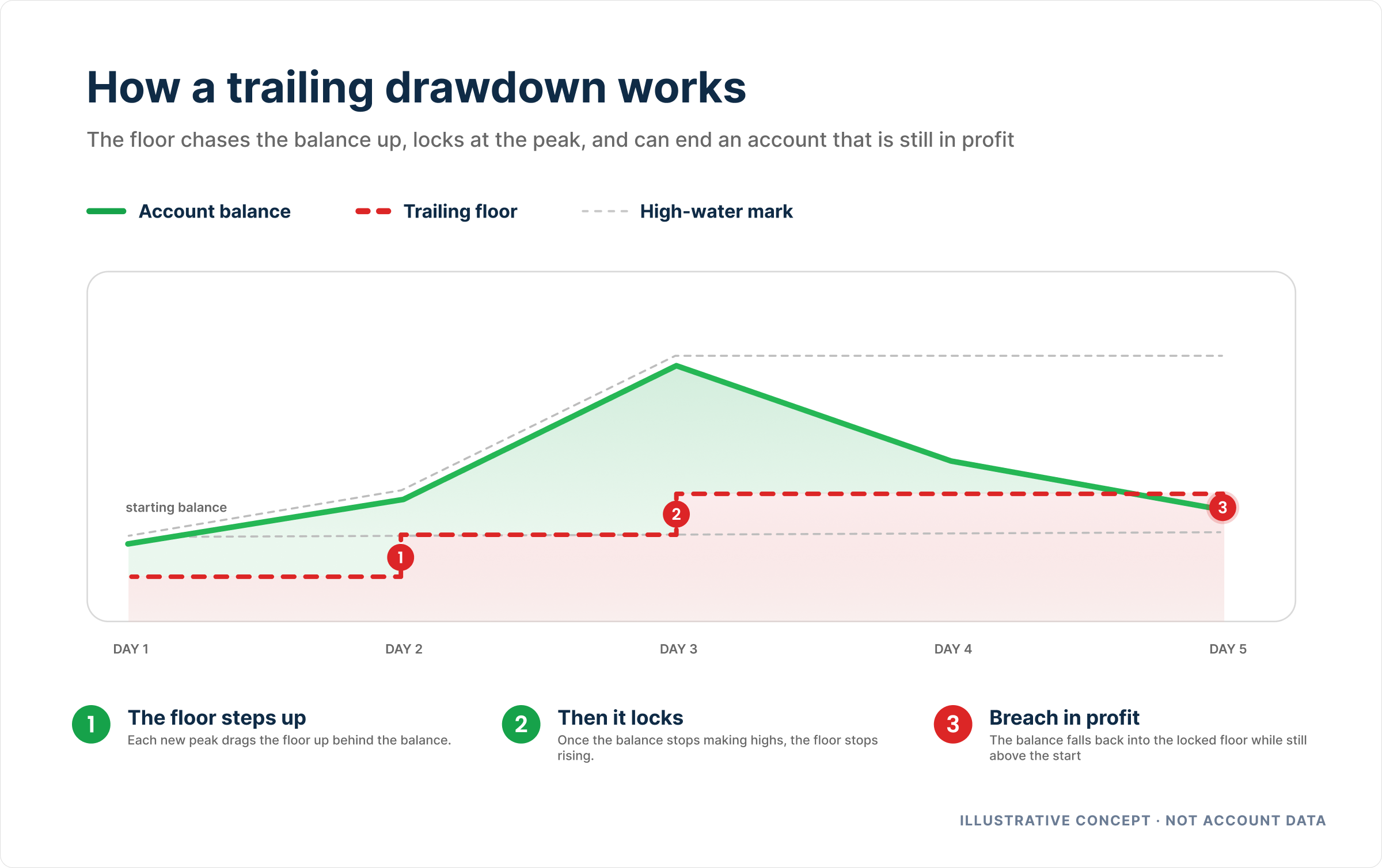
An EOD ratchet rises with the highest end-of-day balance. Topstep's Maximum Loss Limit updates at the end of each trading day but is monitored in real time throughout the session (source: Topstep Maximum Loss Limit). Apex EOD drawdown is calculated from the highest end-of-day balance, with real-time net equity monitoring, and unrealized intraday highs do not raise the threshold (source: Apex EOD Drawdown Explained). Only closes move this floor.
Intraday equity ratchets
An intraday ratchet follows the highest intraday equity, including unrealized gains. Apex's Intraday drawdown uses peak balance including unrealized gains (source: Apex Intraday Drawdown Explained). MFFU's intraday drawdown guide confirms the same basis, with real-time equity breach determination (source: MFFU Intraday Drawdown Explained). Open profits temporarily raise the floor while positions run, which is why this family leaves the least room for giveback.
Floor updating versus real-time monitoring
Two questions are often confused: when the floor moves, and when it is checked. A floor that updates only at day end can still be breached intraday, because monitoring is real time. Topstep's floor moves at day end while breaches are watched throughout the session (source: Topstep Maximum Loss Limit). Tradeify enforces its trailing floor against real-time net liquidation value (source: Tradeify Trailing Max Drawdowns). Updating and monitoring are separate properties of a rule.
Daily resets versus lifetime maximums
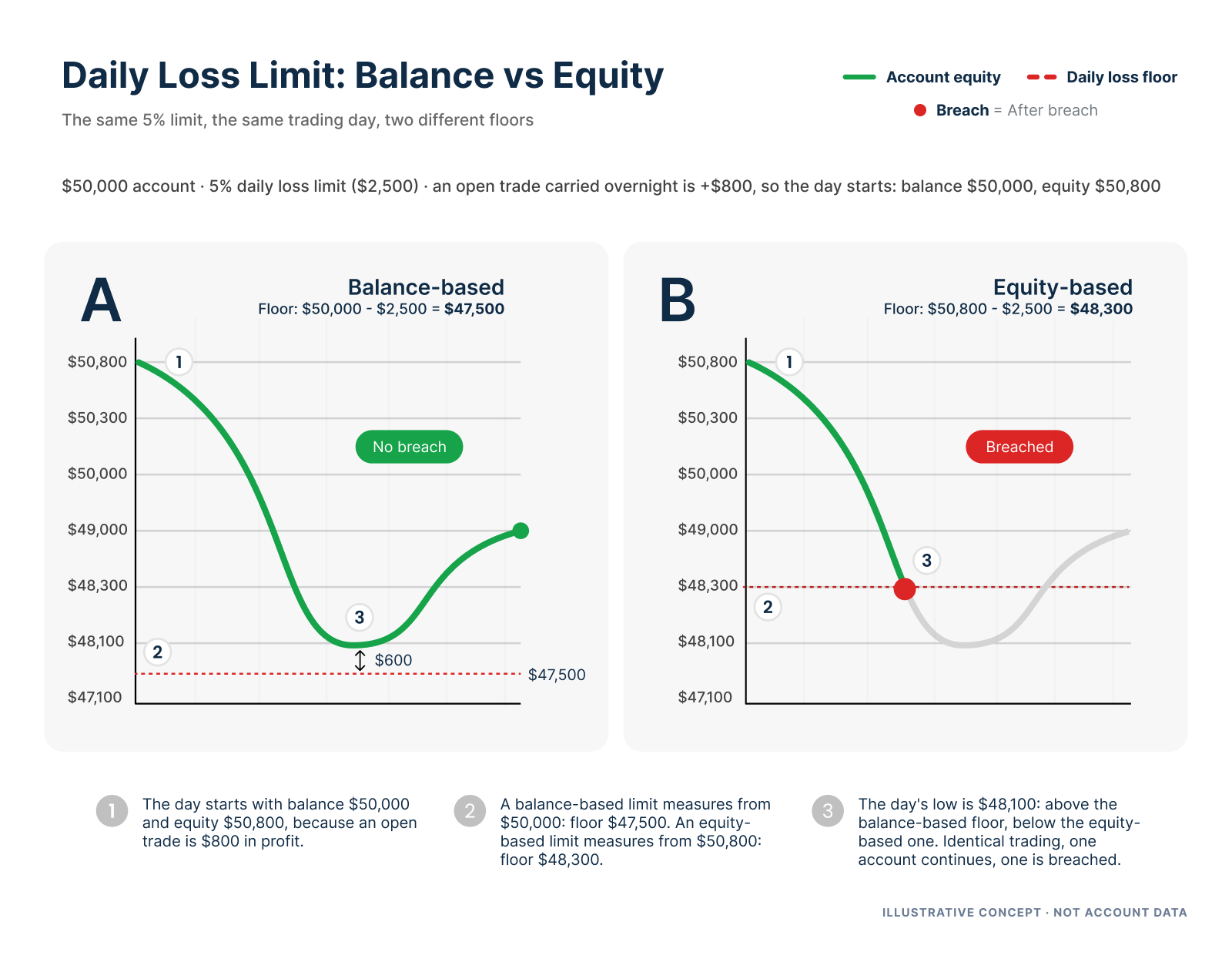
The daily loss allowance resets each session; the maximum drawdown floor is a lifetime constraint, and the two operate simultaneously. FTMO 2-Step runs its 5% daily loss alongside its 10% static maximum (source: FTMO Trading Objectives). The daily mechanics are covered in daily loss limit, and you can trace entered marks in the trailing drawdown simulator, though it cannot see intervening prices.
Caps and post-payout resets
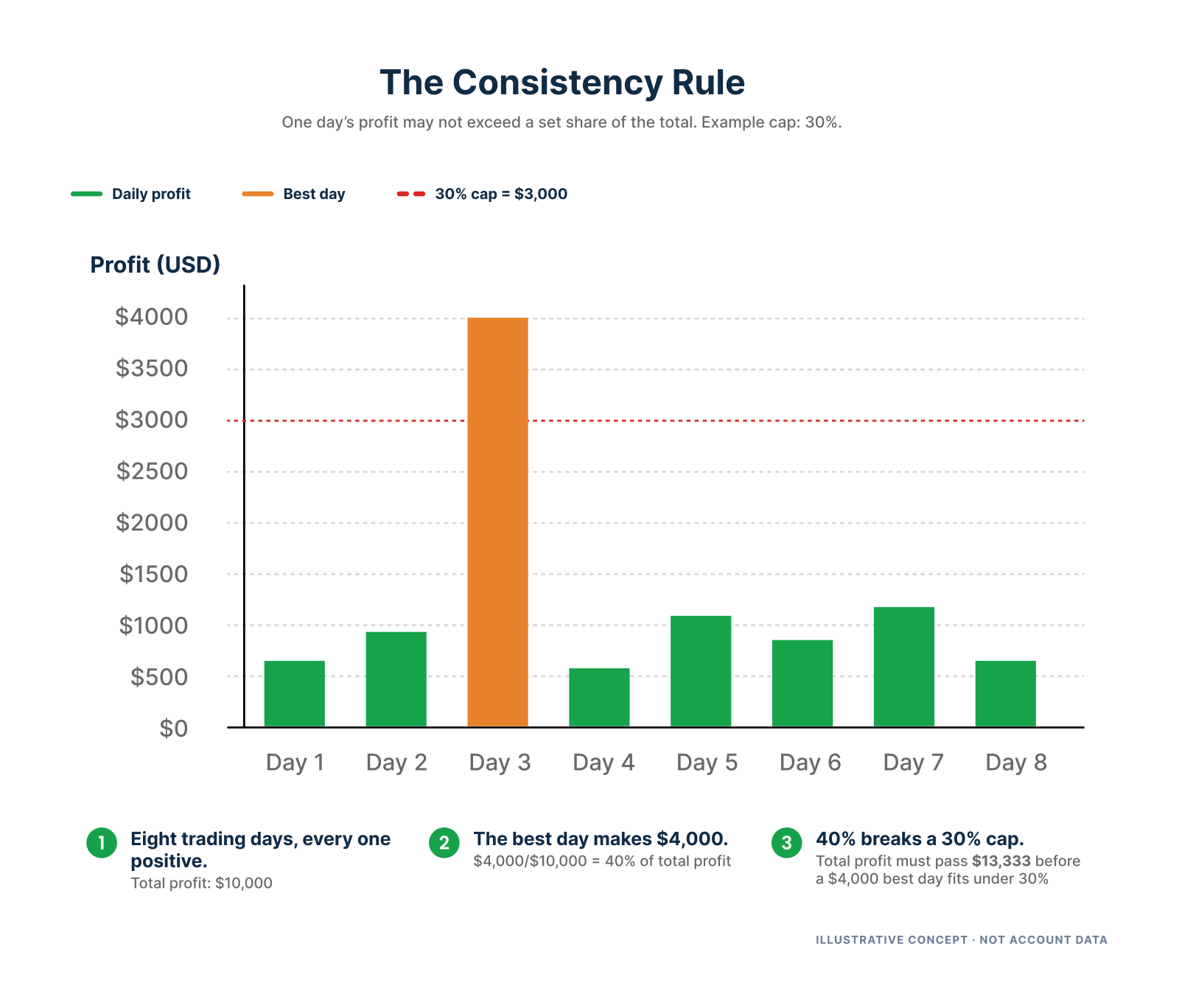
Trailing floors often stop at a cap. Apex EOD performance accounts stop the EOD threshold once it reaches starting balance plus 100 (source: Apex EOD Drawdown Explained). Tradeify Select Flex locks its floor at 50,100 when the EOD balance reaches 52,100 or a payout is requested, whichever occurs first (source: Tradeify Trailing Max Drawdowns). Topstep's Express Funded Account locks at zero on reaching 2,000 or the first payout, whichever occurs first, and the first payout restarts the qualifying-day count (source: Topstep Maximum Loss Limit). Payout rules also interact with consistency requirements at the funded stage.
An original parallel illustration
This parallel illustration is original arithmetic, not observed trades. Start 50,000, drawdown distance 2,000. Intraday equity peaks at 53,000, then the account closes flat at 51,000. Under a static floor, the floor stays at 48,000. Under an EOD ratchet, the floor becomes 49,000 at the next session, after the 51,000 close. Under an uncapped intraday ratchet, the floor is 51,000 immediately at the peak. No special floor cap is assumed in this illustration; capped programs would stop earlier. The futures comparison shows which recorded programs use which type, and the Topstep vs Apex comparison separates EOD from intraday paths.
Drawdown by program and account stage
This evidence base covers six specific 50K futures programs from four firms, checked on 3 October 2026. It distinguishes evaluation from simulated funded stages and records a source and date for each field. It is not an exhaustive market survey and not an independent live trading or payout experiment. The comparison tables present published attributes and conditional trade-offs; they do not rank reliability, pass rates or earnings.
Source records checked . Selected paths only. Optional add-ons excluded.
Evaluation stage
| Program | Loss allowance | Floor updates | Monitoring | Floor cap |
|---|---|---|---|---|
| TopstepTrading Combine Standard pricing / XFA Standard / no DLL add-on | $2,000.00 [4] | End-of-day trailing [4] | Real-time net equity [4]Realized and unrealized losses can breach the current floor intraday. | $50,000.00 [4] |
| Apex Trader FundingEOD Evaluation No Activation Fee / PA / Rithmic | $2,000.00 [8] | End-of-day trailing [8] | Real-time net equity [9] | $53,000.00 [9]Rithmic/Wealthcharts evaluation floor caps at target-profit balance. Tradovate keeps trailing. |
| Apex Trader FundingIntraday Evaluation No Activation Fee / PA / Rithmic | $2,000.00 [12] | Intraday trailing [12] | Real-time net equity [13] | $53,000.00 [13]Rithmic/Wealthcharts evaluation floor caps at target-profit balance. Tradovate keeps trailing. |
| MyFundedFuturesBuilder Default / 2000 MLL / current one-time purchase | $2,000.00 [21] | End-of-day trailing [21] | Not verified [21]Guide describes open-equity breach determination at day end. Continuous intraday enforcement is not explicitly verified. | Not verified [21]The guide gives a general +100 locking statement, without a separate evaluation lock table. |
| MyFundedFuturesRapid Intraday / current one-time purchase | $2,000.00 [30] | End-of-day trailing [30] | Not verified [30]Exact intraday enforcement for the evaluation stage not verified. | Not verified Evaluation floor locking not explicitly verified. |
| TradeifySelect Evaluation 40% / Select Flex / new purchase after 1 Sep 2026 | $2,000.00 [25] | End-of-day trailing [26] | Real-time net liquidation value [26] | Not applicable [26]Evaluations do not lock their drawdown floor. |
Simulated funded stage
| Program | Loss allowance | Floor updates | Monitoring | Floor cap |
|---|---|---|---|---|
| TopstepTrading Combine Standard pricing / XFA Standard / no DLL add-on | $2,000.00 [4] | End-of-day trailing [4] | Real-time net equity [4] | $0.00 [4] |
| Apex Trader FundingEOD Evaluation No Activation Fee / PA / Rithmic | $2,000.00 [10] | End-of-day trailing [10] | Real-time net equity [10] | $50,100.00 [9] |
| Apex Trader FundingIntraday Evaluation No Activation Fee / PA / Rithmic | $2,000.00 [14] | Intraday trailing [14] | Real-time net equity [14] | $50,100.00 [13] |
| MyFundedFuturesBuilder Default / 2000 MLL / current one-time purchase | $2,000.00 [21] | End-of-day trailing [21] | Not verified [21]Exact real-time enforcement is not clear in this plan-specific guide. | $100.00 [21]General account-rule lock at starting balance plus 100. Live table separately says zero. |
| MyFundedFuturesRapid Intraday / current one-time purchase | $2,000.00 [30] | Intraday trailing [30] | Real-time net equity [32] | $100.00 [30] |
| TradeifySelect Evaluation 40% / Select Flex / new purchase after 1 Sep 2026 | $2,000.00 [27] | End-of-day trailing [26] | Real-time net liquidation value [26] | $50,100.00 [26] |
Frequently Asked Questions
Which drawdown type leaves the least room?
By construction, an intraday equity ratchet can leave the least room, because unrealized peaks raise the floor while positions are open. A static floor leaves the most predictable room. The same 2,000 distance produces three different floors in the illustration above.
Can unrealized gains raise my floor?
Only under intraday equity ratchets. Apex Intraday and MFFU's intraday drawdown include unrealized gains in the peak. Topstep, Apex EOD and Tradeify EOD thresholds move on end-of-day balances, so unrealized intraday highs do not raise them.
Does a payout change my floor?
It can. Topstep's first payout sets the MLL to zero and restarts the qualifying-day count. A Tradeify Select Flex payout request can lock the floor at 50,100 immediately. Apex performance accounts carry a separate 2,100 lifetime profit safety net distinct from the drawdown floor. Check the exact program and stage.