



























Education
Consistency Rule Prop Firm: How It Works
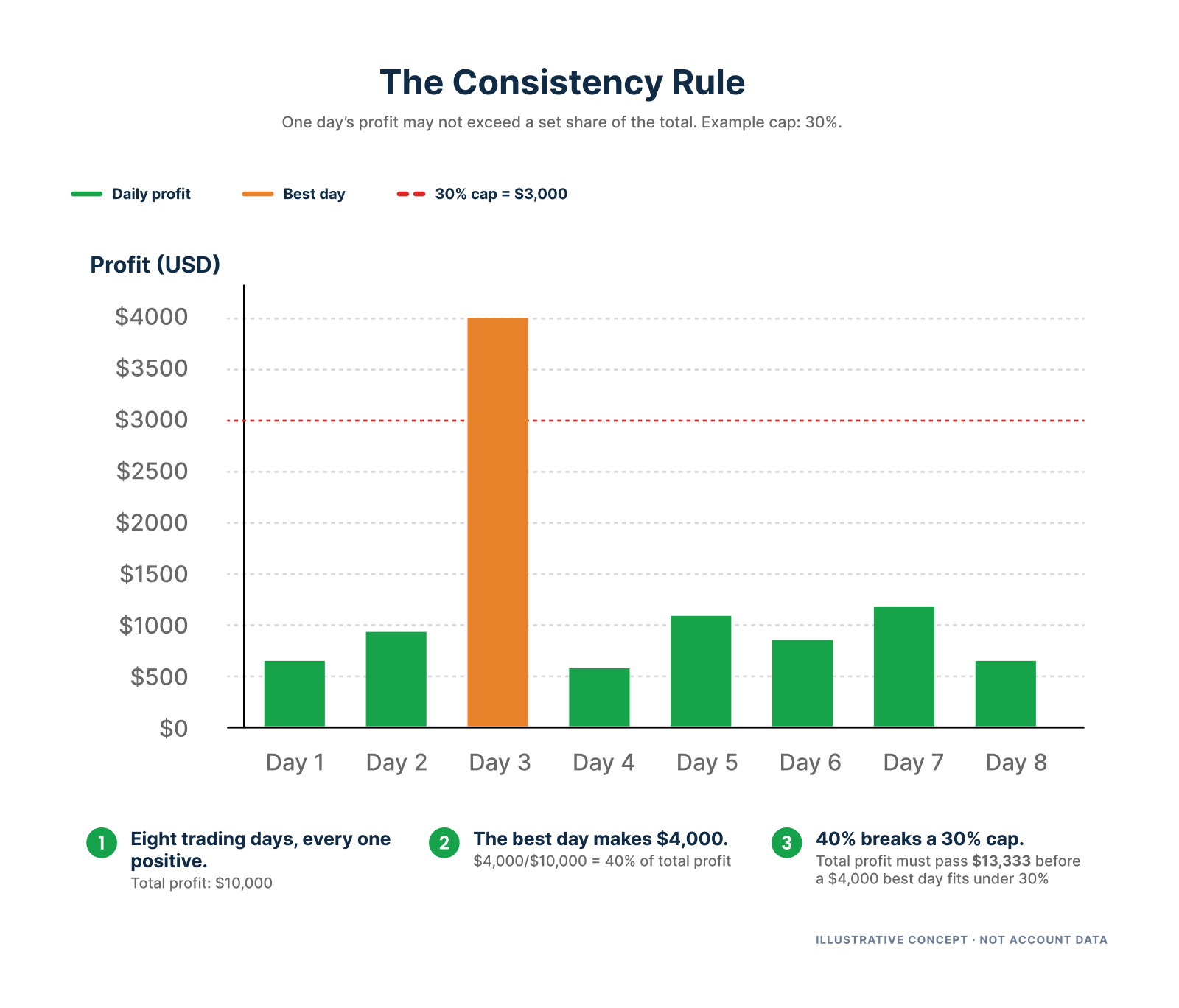
Calculate best-day profit as a share of net profit. Compare strict and inclusive limits and rules at evaluation and funded stages.
Jul 22, 2026 3 min read

Independently ranking 28 forex prop firms
Every ranking is built from a single verified data record. Transparent scores across 28 evaluated firms with no guesswork, no paid placements.

As Seen On







Before comparing evaluation rules, payout policies, or pricing, first decide which market you actually trade. If you trade currency pairs, start with our forex guide. Futures traders can compare programs on our futures page. Crypto traders should review the crypto guide instead.
FundedNext leads on 97/100, ahead of BrightFunded (95) and Eightcap Challenges (93), across all 28 prop firms we track. Scores come from verified data, and change only when a firm's data does.
See all rankingsScores are produced by our published methodology. See the full rankings for every firm we track.
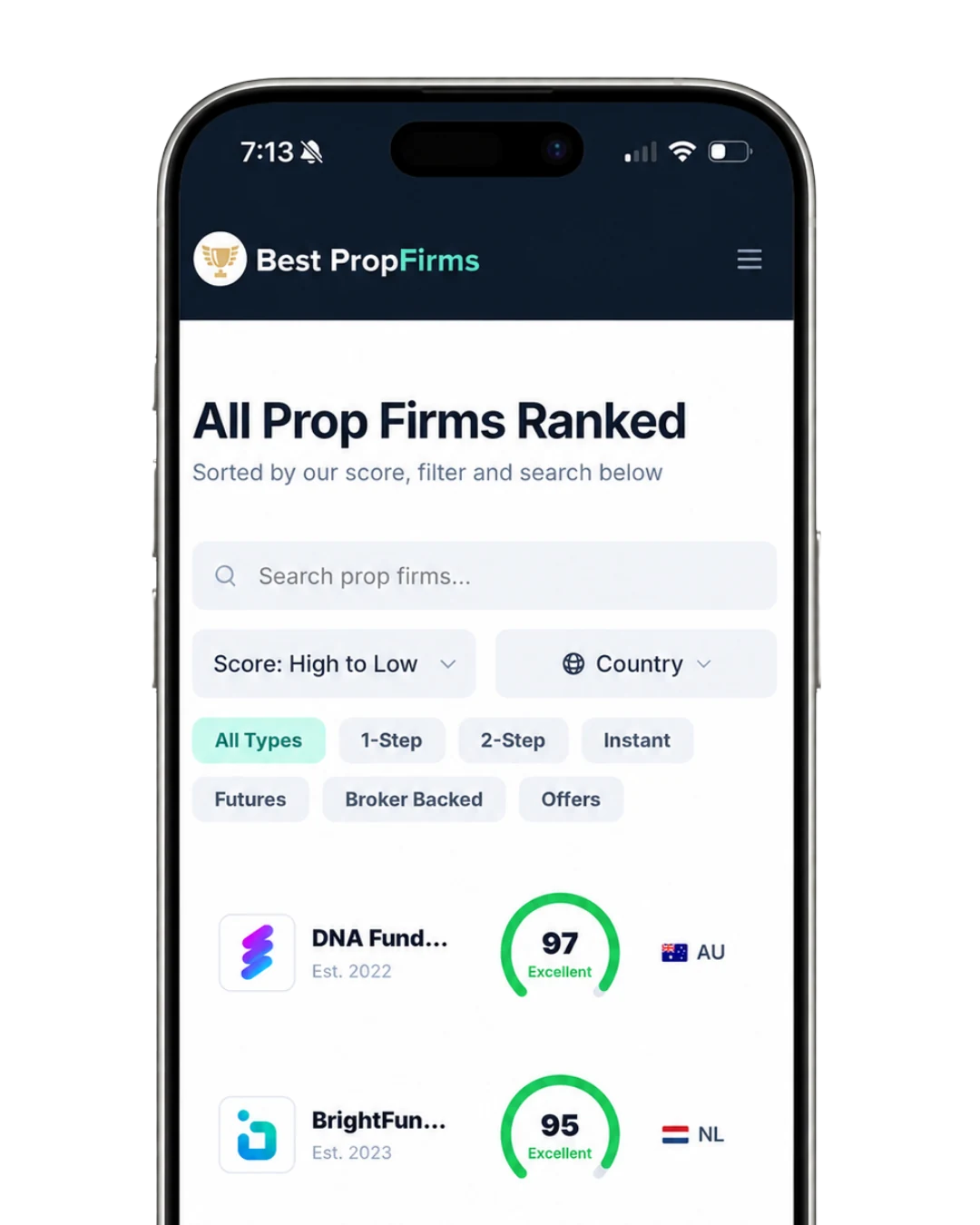
Sorted by our score, filter and search below
Search by firm name, filter by evaluation type, broker backing or active offer, and sort by BPF Score or rank. All 28 prop firms stay on the page — nothing is hidden behind pagination.
| Country | Profit split | Challenge from | Platforms | Promo | Review | ||
|---|---|---|---|---|---|---|---|
1  | 97 Excellent out of 100 | AE | 95% | $32.99 | MT4, MT5, cTrader, Match-Trader | 7% OFF | Read Review Visit FundedNext |
2  | 95 Excellent out of 100 | NL | 100% | $47 | cTrader, DXTrade, MT5 | 20% OFF | Read Review Visit BrightFunded |
3  | 93 Excellent out of 100 | SC | 80% | $5 | MT4, MT5, TradeLocker, TradingView | 20% OFF | Read Review Visit Eightcap Challenges |
4  | 91 Excellent out of 100 | VC | 90% | $25 | MT4, MT5, DXTrade, TradeLocker | 20% OFF | Read Review Visit Blueberry Funded |
5  | 90 Excellent out of 100 | MU | 100% | $19 | MT4, MT5, DXTrade, TradingView | 26% OFF | Read Review Visit FXIFY |
6  | 79 Good out of 100 | LC | 80% | $74 | MT5 | 25% OFF | Read Review Visit IC Funded |
7  | 75 Fair out of 100 | CZ | 90% | $79 | MT4, MT5, cTrader, TradingView | No Offer - | Read Review Visit FTMO |
8  | 73 Fair out of 100 | IL | 100% | $19 | MT5, cTrader | 10% OFF | Read Review Visit The5ers |
9  | 68 Below Avg out of 100 | AE | 100% | $29 | MT5, MatchTrader | No Offer - | Read Review Visit City Traders Imperium |
10  | 68 Below Avg out of 100 | US | 100% | $40 | Match-Trader, MT5, cTrader, TradeLocker, E8 Futures Platform, Tradovate | No Offer - | Read Review Visit E8 Markets |
11  | 66 Below Avg out of 100 | AE | 88% | $30 | MT5, Match-Trader | No Offer - | Read Review Visit Moneta Funded |
| 12 FT For Traders | 64 Below Avg out of 100 | AE | 90% | $29 | MetaTrader 5, cTrader, TradeLocker, For Traders X | No Offer - | Read Review Visit For Traders |
13  | 63 Below Avg out of 100 | IL | 80% | $47 | TraderEvolution | No Offer - | Read Review Visit Trade the Pool |
14  | 60 Poor out of 100 | GB | 90% | $39 | TradingView, ThinkTrader | No Offer - | Read Review Visit Think Capital |
15  | 56 Poor out of 100 | AE | 100% | $29 | MetaTrader 5, cTrader, Match-Trader | No Offer - | Read Review Visit Funding Pips |
16  | 56 Poor out of 100 | CY | 90% | $5 | MT4, MT5 | No Offer - | Read Review Visit Atmos Funded |
17  | 51 Poor out of 100 | LI | 80% | $49 | cTrader, NinjaTrader, Tradovate, Rithmic, Quantower, ATAS, Volsys, Volumetrica, TradingView | No Offer - | Read Review Visit The Trading Pit |
18  | 51 Poor out of 100 | GB | 100% | $89 | MT5, DXTrade, Match-Trader, cTrader | No Offer - | Read Review Visit Funded Trading Plus |
19  | 46 Poor out of 100 | MU | 95% | $13 | MT4, MT5 | No Offer - | Read Review Visit Hantec Trader |
20  | 46 Poor out of 100 | CA | 90% | $60 | cTrader, DXTrade | No Offer - | Read Review Visit Lark Funding |
21  | 41 Poor out of 100 | IT | 95% | $5 | MetaTrader 5, TradeLocker, Match-Trader | No Offer - | Read Review Visit Funded Elite |
22  | 31 Poor out of 100 | CA | 80% | $13 | cTrader, Match-Trader, MT5 | No Offer - | Read Review Visit Maven Trading |
23  | 27 Poor out of 100 | AE | 100% | $19 | MT5, TradeLocker, Match Trader, cTrader | No Offer - | Read Review Visit AquaFunded |
24  | 67 Below Avg out of 100 | GB | 90% | $50 | MetaTrader 5, cTrader, DXTrade, TradeLocker | No Offer - | Read Review Visit Alpha Capital |
25  | 32 Poor out of 100 | AE | 100% | $22 | cTrader, TradeLocker, MatchTrader, Volumetrica, MT5 | No Offer - | Read Review Visit Goat Funded Trader |
26  | 27 Poor out of 100 | LC | 90% | $25 | MT5, cTrader, Match-Trader | No Offer - | Read Review Visit Instant Funding |
27  | 27 Poor out of 100 | — | 90% | $29 | MetaTrader 5, TradeLocker, Match-Trader, NinjaTrader, Tradovate, DeepCharts, TradingView | No Offer - | Read Review Visit Blue Guardian |
28  | 28 Poor out of 100 | US | 99% | $42 | MT5, cTrader, Match-Trader | No Offer - | Read Review Visit The Funded Trader |
Every figure in this table is taken from each firm’s own published challenge terms, payout policy and fee schedule, cross-checked against its Trustpilot profile for the trust component. Last verified . 7 of the 28 firms currently carry a verified discount code. Scores are produced by our published methodology.
We track 28 prop firms in this ranking, of which 28 carry a full score. FundedNext leads on 97/100, ahead of BrightFunded on 95/100 , with the lowest scored firm at 27/100. Scores come from seven weighted criteria - challenges, spreads, markets, payouts, platforms, trust and support - applied identically to every firm, with no paid placement.
Entry pricing starts at $5 for the cheapest evaluation we list. Profit splits reach 100% at the top of the table. The fastest first payout on record is 7 days after funding. 17 of these firms offer an instant funding route that skips the evaluation entirely. 7 carry a verified discount code.
Platform coverage is widest on MT5 (19 firms), cTrader (16 firms) and Match-Trader (10 firms). Check platform support before rules or pricing: a favourable rule set on an execution platform you dislike is a bad trade.
Buyer's guide
Five attributes decide whether a funded account is worth buying, and they matter in this order. Each is scored on every firm in the table above.
One-step challenges test a single profit target; two-step models add a verification phase at a lower target; instant funding skips evaluation entirely for a higher fee. One-step suits traders who hit targets quickly, two-step suits slower, lower-risk approaches, and instant funding only pays off if you are confident enough to skip the cheaper route.
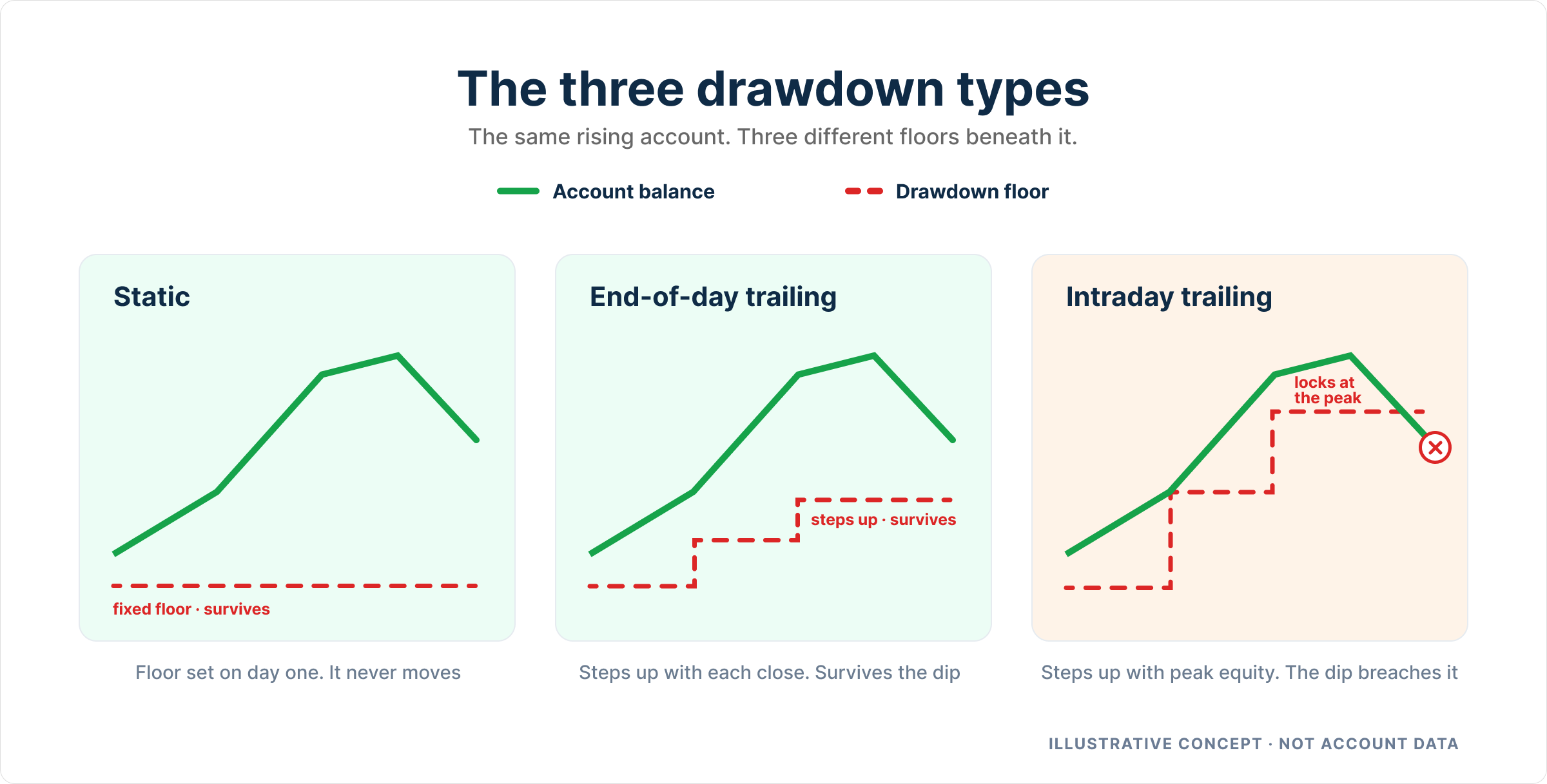
Daily and maximum drawdown decide how much room you have before the account is closed, and how they are measured matters as much as the number. Trailing drawdown that follows your equity high is materially harder to trade than a static limit set from the starting balance, even when both are quoted at the same percentage.
The split is the share of profit you keep once funded. Most firms start between 70% and 80% and step up with consistency; a scaling plan raises the account size after sustained performance. A high split on an account you cannot grow is worth less than a moderate split with a real scaling path.
Payout frequency, first-payout waiting period, processing time and withdrawal minimum together decide when money actually reaches you. Bi-weekly cycles are the common baseline and weekly is fast; the first payout usually waits longer than the ones that follow it.
The platform decides how you execute and which tools you get. Check that the firm supports the platform you already trade before anything else on this list, because a favourable rule set on an execution platform you dislike is a bad trade.
Connect with thousands of prop firm traders inside our Discord. Get real-time deal alerts, verified payout proof, firm rule changes as they happen, and honest discussion about which challenges are actually worth taking - all in one place, and free to join.
traders already in the community
Join DiscordOur Process
We read the firm's official terms, challenge rules, payout policies, and T&Cs. All data sourced directly with no third-party aggregators.
Each firm is scored across 7 categories: challenges, spreads, markets, payouts, platforms, trust and support. Challenges and payouts carry the heaviest weights because they decide what you pay and what you take home; support weighs least.
Data stored in one canonical record. Every metric on every page flows from that source with no duplicated values, no stale data.
Who's Behind the Scores

Justin Grossbard
CEO & Co-Founder
Co-founder of CompareForexBrokers with 10+ years covering brokers and prop firms. Leads the CFD review lane.

Noam Korbl
COO & Co-Founder
Co-founder of BestPropFirms and CompareForexBrokers. Leads the futures and payouts review lanes.
Read more about the team on our about page.
Got Questions?
Everything you need to know about prop trading firms and how we rank them.
From The Blog
Guides and explainers on how prop firms actually work, written against the same verified data as our rankings.
Calculate best-day profit as a share of net profit. Compare strict and inclusive limits and rules at evaluation and funded stages.
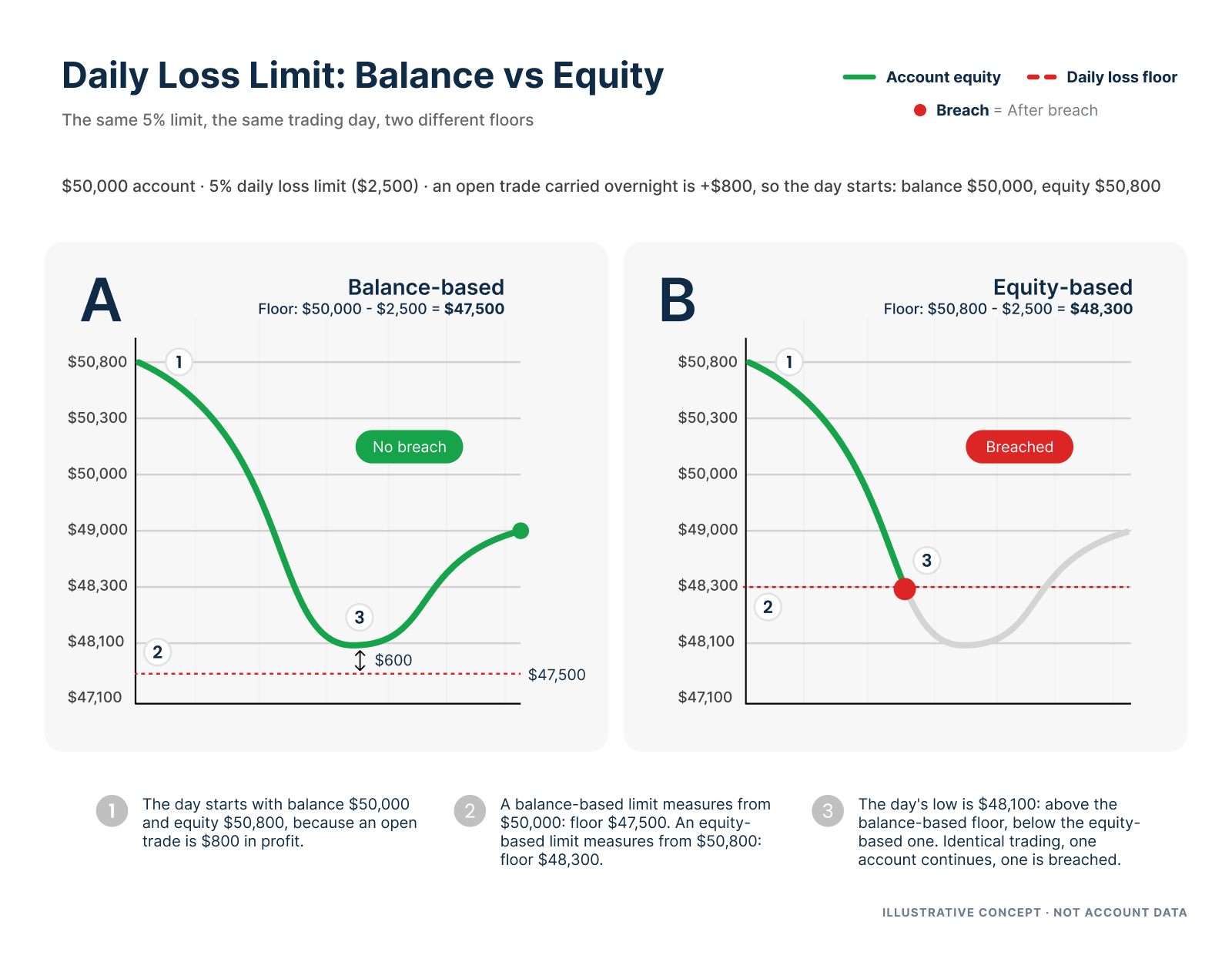
Calculate daily loss headroom from your opening balance, fixed allowance and net P/L. Compare reset risk and scoped programme rules.
Compare static, end-of-day and intraday drawdown floors, live equity monitoring, caps and payout effects using dated programme sources.